SOP for Biotechnology (2026): Format, Samples, & Writing Tips
Updated On
-
Copy link
-
-
Submitting a strong Statement of Purpose SOP for biotechnology increases your chances of university admission approval. Check out the guide for updated writing guidelines 2026, format, along with samples for writing SOP for Biotechnology

Your Complete Canada PR Roadmap- From Eligibility to Visa

Table of Contents
Have you ever wondered what it takes to craft an exceptional SOP that will set you apart from the competition and open doors to your dream biotechnology program abroad?
If you've ever found yourself lost in the abyss of application essays, struggling to articulate your passion for biotechnology and showcase your suitability for the program, then this blog is for you! Here, we'll unravel the secrets to crafting an SOP for Biotechnology that will capture the attention of admission committees and leave a lasting impression.
Statement of Purpose (SOP) for BiotechnologyÌý
A Statement of Purpose for Biotechnology, like any other program, is a personal essay required for admission into biotechnology programs, particularly at the Master’s level. Here is what SOP in Biotechnology means:Ìý
- The SOP reflects the candidate's career aspirations related to the biotechnology field.
- It serves as a first impression for admission committees, showcasing your passion for biotechnology and how the program aligns with their future goals.
- Your SOP should have relevant skills, achievements, and experiences such as internships, projects, and domain knowledge.
- It must also explain why the specific program and university are the right fit for the applicant.Ìý
SOP for Biotechnology Guidelines for 2026
Below are the guidelines that you must follow before you begin writing your SOP. Following these guidelines will help you create a winning SOP and thus increase your chances of admission to the university.
- Start early and give yourself enough time to write and revise your SOP
- Brainstorm your ideas and outline your SOP before you start writing
- Research the program you are applying to and make sure that your SOP is relevant to the program's goals and objectives
- Read and analyze sample SOPs from successful applicants to get an idea of what a strong SOP looks like
- Talk to your professors, advisors, or other mentors to get feedback on your SOP
- Get feedback on your SOP from friends, family, or other trusted readers
- Proofread your SOP carefully for any errors in grammar or spelling
Tips for Writing a Standout SOP for BiotechnologyÌýÌý
Below are the tips for writing an SOP for Biotechnology that you should consider when clearly articulating your motivations for choosing the program, and showcasing how it aligns with your career goals.
- Use a clear and concise writing style
- Be yourself and let your personality shine through
- Highlight your most relevant experiences and accomplishments
- Use specific examples to illustrate your points
- Quantify your achievements whenever possible
- Explain how your experiences and qualifications make you a good fit for the program
- Proofread your SOP carefully before submitting it
In addition to the general tips above, here are some specific tips for writing a strong SOP for biotechnology:
- Start by telling a compelling story about your passion for biotechnology
- Describe your most relevant research experience
- Highlight your technical skills and knowledge
- Explain how your experiences and qualifications will help you succeed in the program
- End by reiterating your interest in the program and your commitment to making a positive impact in the field of biotechnology
Explore: How to Write SOP for an Australia Student Visa?
SOP for Biotechnology Format 2026
In an SOP for Biotechnology, begin with a concise introduction highlighting your keen interest in the field, you could also use quotes that align with your passion for biotechnology. Follow the below-structured format to showcase why you think you are a good fit for the program.
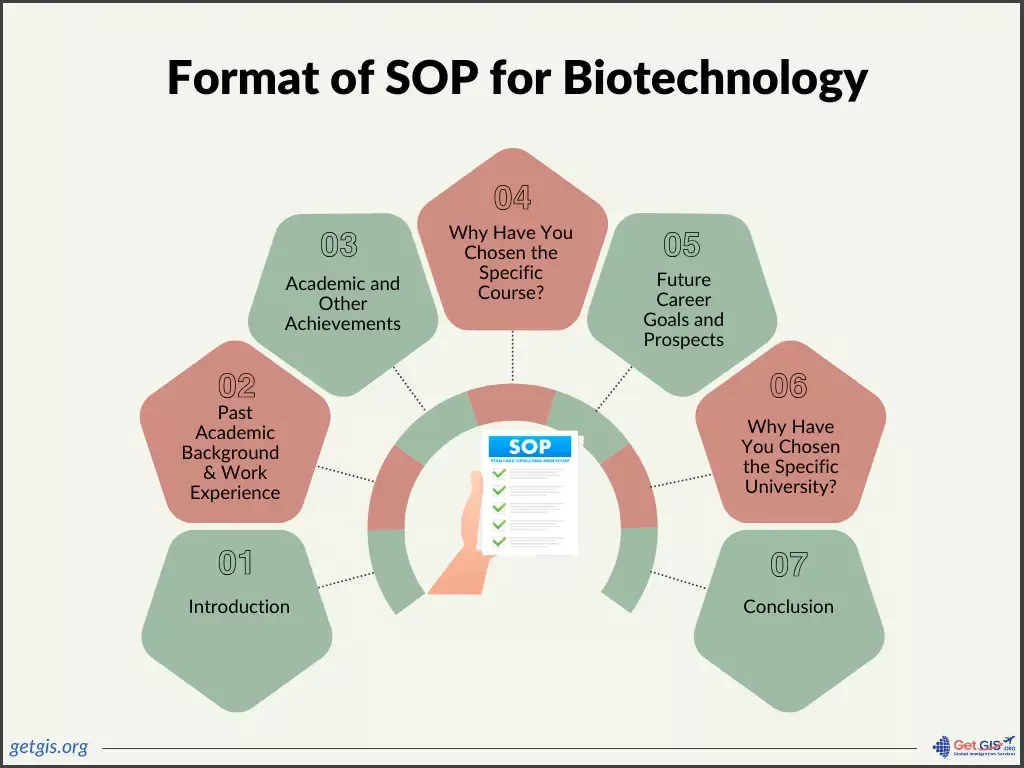
1. Introduction
Begin your SOP with a compelling introduction that offers a glimpse into your journey and background. Briefly share what sparked your interest in biotechnology and how it aligns with your aspirations. This section serves as an invitation for the reader to delve into your unique story.
2. Past Academic Background and Professional Experiences
Delve into your academic journey and professional experiences in the second paragraph. Highlight key academic milestones, relevant courses, and any research projects or internships that have shaped your understanding of biotechnology. Provide insights into how these experiences have contributed to your academic and professional growth.
3. Academic and Other Achievements
In the third paragraph, showcase your academic achievements, emphasizing any honors, awards, or noteworthy accomplishments. If applicable, mention extracurricular activities, publications, or leadership roles that demonstrate your multifaceted skills and commitment to excellence.
4. Why Have You Chosen the Specific Course?
In the fourth paragraph, articulate your motivation behind choosing a specific course in biotechnology. Discuss how your past academic background and experiences have led you to this particular specialization. Highlight the aspects of the course curriculum that resonate with your career aspirations and intellectual interests.
5. Future Career Goals and Prospects
Clearly outline your future career goals in the fifth paragraph. Discuss how the biotechnology program aligns with your long-term objectives. Share your vision for contributing to the field, whether through research, innovation, or practical applications. Showcase your understanding of the industry and how you see yourself making a meaningful impact.
6. Why Have You Chosen a Specific University?
In the sixth paragraph, elaborate on why you have chosen the specific university for your biotechnology studies. Discuss the university's unique offerings, faculty expertise, research opportunities, or any distinctive features that set it apart. Showcase your research into the university's programs and resources that align with your academic and career goals.
7. Conclusion
Conclude your SOP by summarizing your key points and reiterating your enthusiasm for pursuing biotechnology at your chosen university. Express gratitude for the opportunity to apply and convey your eagerness to contribute to the academic community. End with a confident statement that leaves a lasting impression on the reader.
Sample SOP for BiotechnologyÌý
An effective SOP should convey your enthusiasm for hospitality, your unique strengths, and the specific skills you aim to develop in the chosen program. Refer to the below-given sample SOPs
SOP for Biotechnology Sample 1
|
Biotechnology has emerged as one of the fastest-growing industries in the modern world, which combines Biological Sciences with advanced technologies to address challenges in sectors like healthcare, agriculture, environmental stability, and industry. This integration of genetic engineering, molecular biology, and bioengineering has created transformative opportunities for innovation. Considering its broad applications and immense career opportunities, biotechnology offers countless opportunities for young graduates to contribute to scientific progress. With a strong interest in this dynamic field, I aspire to gain a deep understanding of the various branches of biotechnology and develop into a skilled biotechnology professional. Today's biotechnology and pharmaceutical industries are looking out for highly skilled professionals who possess expertise in areas such as stem cell research, genetic engineering, CRISPR technology, personalized medicine, and synthetic biology. Leading research institutions, pharmaceutical companies, and technology organizations are providing numerous opportunities for professionals to innovate and contribute to groundbreaking discoveries. However, working in such a globally competitive environment requires individuals who meet international academic and professional standards. And to equip myself with the necessary knowledge and skills, so I intend to pursue advanced programs in biotechnology.Ìý The Master's of Biotechnology program at the University of Toronto offers an interdisciplinary curriculum that integrates scientific knowledge with business and management principles. This full-time two-year program will provide me an ideal platform to work alongside renowned researchers and industry professionals while gaining both theoretical knowledge and practical exposure. The Mbiotech program at the University of Toronto is carefully designed to enable students to explore emerging developments in biotechnology through research, industry collaborations, and strategic business approaches. This encourages the development of essential personalized skills such as planning, teamwork, decision-making, leadership, etc. Moreover, the curriculum focuses on addressing global challenges through innovative biotechnological solutions. During the first year, students study subjects such as Biopartnering, Molecular Biology Laboratory, Biotechnology in Medicine and Drug Manufacturing, and Biotechnology in Agriculture, and natural products, which will help me to understand global biotechnology and pharmaceutical markets. In addition, practical training in the management of technological innovation will further help me understand the influence of biotechnology on organizations, technology development, and society as a whole. I have completed my Bachelor of Science in Biology from Loyola college, Hyderabad and pursued a Master of Science in Biotechnology at the University of Delhi, New Delhi. Throughout my academics, I had the opportunity to publish two research papers at international conferences organized by the University of XYZ, where my work received second prize recognition. These experiences further strengthened my understanding of subjects such as microbiology, vaccine production, Biocatalyst, nanobiotechnology, biomaterials, and immunology. During my studies in biology, I gained insights into how flora and fauna interact with the environment and evolve over time. However, I realized that theoretical knowledge alone is insufficient to address the real-world biological challenges, and practical application is equally essential.Ìý Studying a biotechnology program at your university will allow me to enhance my research abilities and analytical thinking skills. With the curriculum's emphasis on management concepts, it will further provide valuable insights into how biotechnology innovations are developed, managed, and commercialized. Additionally, the program will help me improve my presentation, reporting, writing, and communication skills while strengthening my proficiency in technological tools and other professional software. These experiences will also foster teamwork, leadership, time management, and negotiation skills, which are essential in scientific and corporate environments. Overall, the Master's program in biotechnology offers a unique learning environment that combines academic excellence with practical exposure. Its interdisciplinary approach provides students with opportunities to explore innovative ideas and contribute meaningfully to scientific advancement. I'm confident that this program will empower me with the knowledge, skills, and experience required to make valuable contributions to biotechnology research and industry. With dedication and creativity, I hope to adopt an innovative approach to learning and contribute positively to society through advancement in biotechnology. |
SOP for Biotechnology Sample 2
|
Growing up in the bustling metropolis of Delhi, India, I have always been fascinated by the intricate workings of the human body and the immense potential of biomedical engineering to revolutionize healthcare. From a young age, I was captivated by the stories of scientists and engineers who were developing groundbreaking medical technologies that were transforming lives. This fascination propelled me towards pursuing a Bachelor of Technology in Biomedical Engineering from Shiv Nadar University, Delhi, where I gained a solid foundation in the principles of engineering and biology, and developed a deep-seated passion for applying these principles to address real-world medical challenges.Ìý During my undergraduate studies, I actively participated in various research projects that provided me with hands-on experience in the field of biomedical engineering. I collaborated in the development of a novel biomaterial scaffold for tissue engineering applications, where I synthesized and characterized biomaterials, assessed their biocompatibility, and evaluated their ability to promote tissue regeneration. This research project not only deepened my understanding of biomaterials and tissue engineering but also instilled in me the importance of interdisciplinary collaboration and the significance of translational research in bringing innovative medical technologies to fruition.Ìý In addition to my research endeavors, I also gained valuable professional experience through internships at leading medical technology companies. At XYZ Medical Devices, I worked as an intern in the research and development department, where I contributed to the design and evaluation of a new implantable device for the treatment of heart disease. This internship exposed me to the complexities and challenges of medical device development, from concept design to clinical testing, and further fueled my desire to contribute to the advancement of healthcare through biomedical engineering.Ìý Throughout my academic journey, I have consistently maintained a strong academic record, graduating with a Bachelor of Technology degree in Biomedical Engineering with a GPA of 3.95. My academic achievements have been recognized through various scholarships and awards, including the Dean's List and the Best Student Award in Biomedical Engineering. Beyond academics, I have also been actively involved in extracurricular activities, serving as the President of the Biomedical Engineering Society at my university and organizing various workshops and seminars to promote STEM education among underprivileged students.Ìý The Master of Science in Biomedical Engineering program at the University of Montreal particularly appeals to me due to its strong emphasis on research and its dedication to translational medicine. The program's interdisciplinary approach, which seamlessly integrates engineering principles with biological and clinical concepts, aligns perfectly with my research interests and career aspirations. I am particularly drawn to the program's research opportunities in the field of tissue engineering, where I hope to further develop my expertise in biomaterials and fabrication techniques.Ìý My ultimate career aspiration is to become a leading biomedical engineer, contributing to the development of life- changing medical technologies that improve patient outcomes and address global healthcare challenges. I envision myself working in a research and development setting, collaborating with scientists and engineers to design, develop, and test groundbreaking medical devices and therapies. I am particularly interested in pursuing research in the field of tissue engineering, where I hope to contribute to the development of novel biomaterials and regenerative medicine strategies for the treatment of injuries and diseases.Ìý The University of Montreal's reputation for excellence in biomedical research and its unwavering commitment to translational medicine make it an ideal place for me to pursue my graduate studies. The university's state-of-the-art research facilities and the expertise of its faculty members provide an unparalleled environment for scientific exploration and innovation. I am particularly impressed by the university's strong collaborations with industry partners, which provide opportunities for real-world application of research findings and contribute to the development of cutting-edge medical technologies.Ìý I am confident that my strong academic background, my research experience, and my unwavering passion for biomedical engineering make me an ideal candidate for the Master of Science in Biomedical Engineering program at the University of Montreal. I am eager to join the vibrant research community at the university, where I can further develop my skills and contribute to the advancement of healthcare through innovative biomedical engineering solutions. I am confident that my graduate studies at the University of Montreal will equip me with the necessary knowledge, skills, and mentorship to achieve my career goals and make a meaningful impact on the world. |
Also Read:ÌýStatement of Purpose (SOP) for Masters: Sample, Format, and Guidelines
Common Mistakes to Avoid in a Biotechnology SOPÌý
A good biotechnology SOP should have a clear sectional introduction to guide the reader through your story logically and professionally. Here are the common mistakes to avoid in a biotechnology SOP:
- Being too Generic: The SOP should be specifically written to the biotechnology program and not like it fits with any other course.ÌýÌý
- Using Plagiarism: Copying content can cause the SOP to be rejected since universities check the originality of the content.ÌýÌýÌý
- Adding Irrelevant Information: Keep the SOP focused on biotechnology-related experiences and goals; avoid overly personal and outdated details.Ìý
- Random details without structure: Make sure that logical flow (logic, reason, coherence, flow) connects your background, motivation, and goals.
- Use of Informal Language: Using informal language or slang; the tone should be formal and professional.
Master Your SOP Journey with ³ÉÈËÿÈÕ´óÈü
In conclusion, crafting an exceptional Statement of Purpose (SOP) for your biotechnology endeavors is pivotal to unlocking the doors to academic success. As you embark on this journey, consider seeking expert assistance from services like ³ÉÈËÿÈÕ´óÈü for study abroad services. We not only streamline the application process but also provide invaluable insights and guidance, ensuring your SOP stands out in the competitive landscape.
Schedule a Free Consultation Today to discuss the opportunities available to you. Let us help you create a successful SOP and secure your place at the best universities in the world.
Useful Links
Planning to study in Canada? Explore provinces that improve your PR chances
Frequently Asked Questions
What is SOP in Biotechnology?
Is there a promising future for biotechnology in 2025-26?
How long should my SOP for Biotechnology be?
How can I effectively explain my career goals in my SOP?
What tone and style should I use in my Biotechnology SOP?